Planning around Perth Airport

As a critical element of public infrastructure that operates 24 hours a day, seven days a week, the current and future safety, viability and growth of Perth Airport operations must be appropriately safeguarded against inappropriate land development and activities in the areas surrounding the airport.

Safeguarding is a shared responsibility of Perth Airport and all levels of government.

The Australian Government recognises that the current and future viability of aviation operations at Australian airports can be impacted by inappropriate developments in areas beyond the airport boundary. The National Airports Safeguarding Advisory Group, comprising high-level Federal, State and Territory transport and planning officials, has developed the National Airports Safeguarding Framework (NASF). The NASF is a national land use planning regime that aims to safeguard airports and the communities in their vicinity by supporting and enabling:

  • the implementation of best practice in relation to land use assessment and decision making in the vicinity of airports
  • assurance of community safety and amenity near airports
  • better understanding and recognition of aviation safety requirements and aircraft noise impacts in land use and related planning decisions
  • the provision of greater certainty and clarity for developers and landowners
  • improvements to regulatory certainty and efficiency, and
  • the publication and dissemination of information on best practice in land use and related planning that supports the safe and efficient operation of airports.
Land use planning

BUILDING TYPEACCEPTABLECONDITIONALLY ACCEPTABLEUNACCEPTABLE
House, home unit, flat, caravan parkLess than 20 ANEF20 to 25 ANEFGreater than 25 ANEF
Hotel, motel, hostelLess than 25 ANEF25 to 30 ANEFGreater than 30 ANEF
School, universityLess than 20 ANEF20 to 25 ANEFGreater than 25 ANEF
Hospital, nursing homeLess than 20 ANEF20 to 25 ANEFGreater than 25 ANEF
Public buildingLess than 20 ANEF20 to 30 ANEFGreater than 30 ANEF
Commercial buildingLess than 25 ANEF25 to 35 ANEFGreater than 35 ANEF
Light industrialLess than 30 ANEF30 to 40 ANEFGreater than 40 ANEF
Other industrialAcceptable in all ANEF zones

Source: Australian Standard 2021:2015 Table 2.1

The State Planning Policy 5.1 determines which land uses are acceptable, conditionally acceptable or unacceptable in various ANEF contours can be accessed here.

How was the current ANEF developed?

The ANEF has been used for land use planning purposes in Australia since 1982.

Under the Airports Act 1996, Perth Airport is required to produce an ANEF for technical endorsement by Airservices Australia. The ANEF is incorporated in each airport master plan which is reviewed every five years.

Perth Airport developed its first ANEF 40 years ago as part of the Master Plan 1985. Since that initial noise forecast, which included the new parallel runway, the overall footprint of the ANEF contours has remained relatively the same.

Perth Airport has adopted a composite Australian Noise Exposure Forecast (ANEF) which reflects a combination of two scenarios (referred to as Australian Noise Exposure Concepts) that are based on potential future operating modes.

The ANEF has been prepared using the Aviation Environmental Design Tool software, developed by the US Federal Aviation Administration, which is the most modern noise simulation software package used for aircraft noise modelling. The software contains a database of current civil passenger and military aircraft along with their performance and typical noise characteristics. Input data for the ANEF noise modelling includes the following variables:

  • types of aircraft (aircraft fleet mix)
  • movement volume
  • configuration of the runways and allocation to respective operations
  • arrival and departure tracks flown, along with ascent and descent profiles and flight track dispersal to consider the spread on the track by aircraft operations
  • aircraft destinations or origins (stage lengths) to take into consideration track allocation
  • day/night split of operations
  • terrain data, and
  • normalised wind velocity and temperature information.

Perth Airport has adopted a ‘composite’ Australian Noise Exposure Forecast (ANEF) which reflects a combination of four Australian Noise Exposure Concepts (ANEC) that are based on potential future operating modes.

ANEC 0

ANEC 0

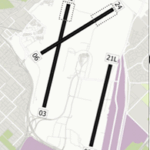
actual FY24 aircraft operations on the existing main runway 03/21 and cross runway 06/24.

ANEC 1

ANEC 1

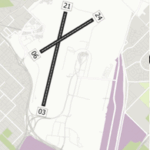
existing main runway 03/21 and cross runway 06/24 with their planned future extensions.

ANEC 2

ANEC 2

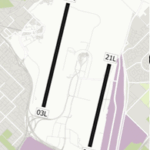
future parallel runway operations for the existing main runway 03/21 and the new runway, operating at their theoretical ultimate capacity.

ANEC 3

ANEC 3

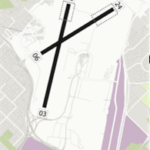
future three-runway operations for the existing main runway 03/21 and cross runway 06/24 with their planned future extensions, as well as the new runway, operating at their theoretical ultimate capacity.