
What are Perth Airport and industry doing to manage the impacts of aircraft noise?

Perth Airport works with Airservices Australia, all levels of government and the aviation industry to actively manage aircraft noise exposure and its effect on the surrounding community, while balancing the need for critical and safe air services.

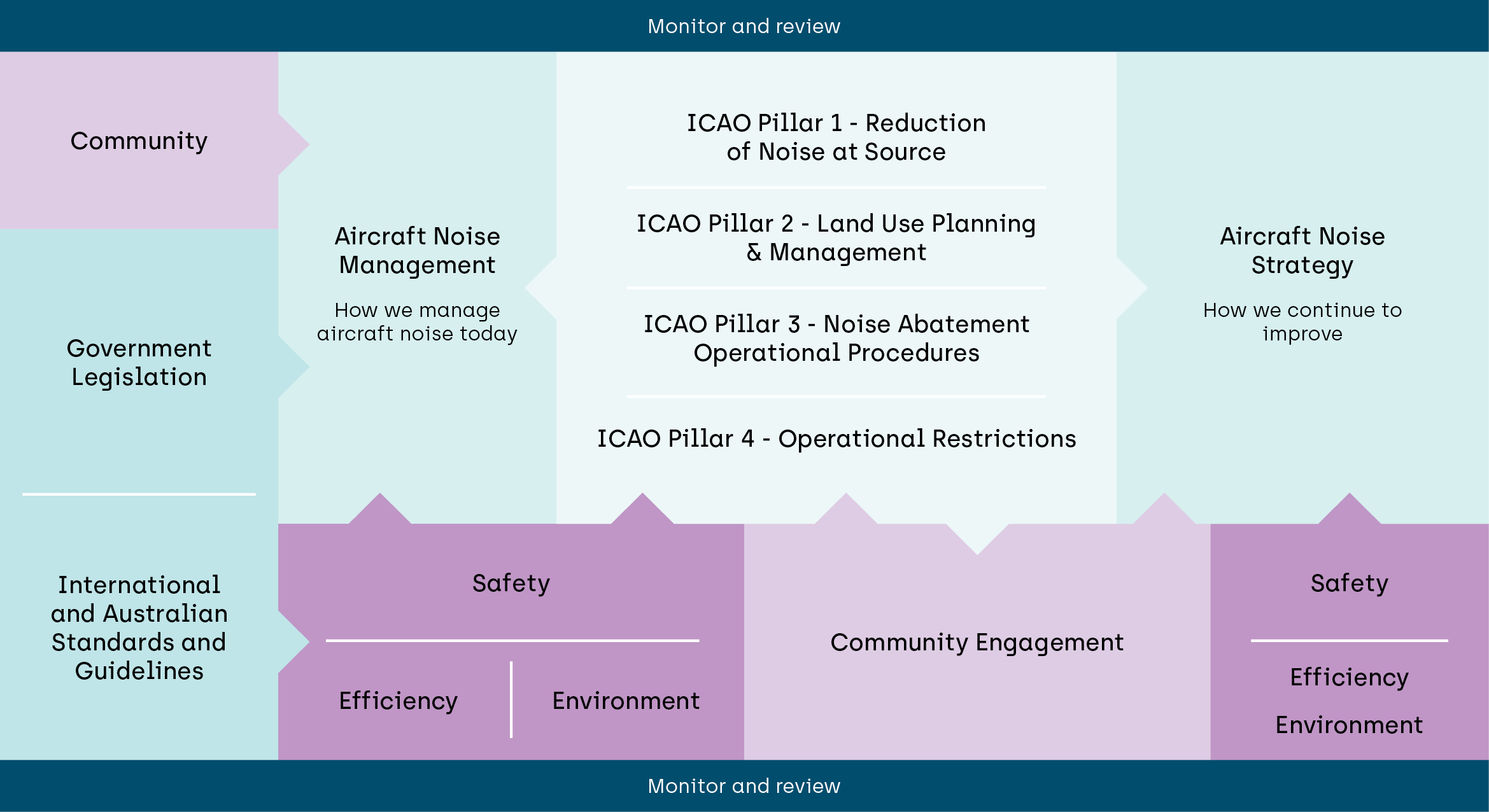
Perth Airport has adopted the International Civil Aviation Organization’s (ICAO) Balanced Approach to Aircraft Noise Management, which is the only globally recognised policy for managing aircraft noise. ICAO’s Balanced Approach consists of identifying the noise problem and analysing various measures available to reduce noise at a specific airport through the exploration of four principal elements, namely:

  • Pillar 1—reduction of noise at source (use quieter aircraft and utilise advanced technologies and airframe design)
  • Pillar 2—land use planning and management (develop controls for land use planning and development around airports)
  • Pillar 3—noise abatement operational procedures (develop specific procedures such as preferential runway use and preferential routes), and
  • Pillar 4—operating restrictions (considered as a last resort if the other pillars are not sufficient).

Community engagement is recognised as a cross-cutting element to support the four pillars of ICAO’s Balanced Approach, with the goal of identifying practical solutions which include community feedback whenever possible.

Perth Airport’s commitment to managing aircraft noise is guided by the Aircraft Noise Management Framework shown below.
Airservices has released its Commitment to Aircraft Noise Management to outlines Airservices’ collaborative manage aircraft noise.

Resources

Airservices provides the WebTrak online system for viewing where aircraft fly and exploring historical trends and patterns. WebTrak uses information from air traffic control secondary surveillance radars to display aircraft movements within 100 kilometres of Perth Airport.

Aircraft noise data is also displayed, collected daily from noise monitors strategically located around communities close to Perth Airport.

Airservices also maintains the Aircraft in Your Neighbourhood portal to provide information about runway use and flight paths for Perth Airport specific to your selected location.

Noise abatement procedures

Every major airport in Australia has noise abatement procedures (NAPs) which are designed to reduce the impact of aircraft noise on the community. The NAPs are developed and reviewed by Airservices, in consultation with airlines and other aircraft operators, airports, community aviation consultation groups, and other stakeholders.

NAPs are implemented by Air Traffic Control and aircraft operators. The use of NAPs is subject to ensuring that the safety and efficiency of the airport are not compromised. Air Traffic Controllers or pilots may not be able to use them in certain situations due to weather conditions, traffic complexity, or the specific operating requirements of individual aircraft.

The current NAPs for Perth Airport state that runway 06 is the least preferred runway for landings (from the southwest) and runway 24 is the least preferred runway for departures (to the southwest), with the other runway directions all equally preferred. This does not mean that the other runway directions are equally used, but rather that there is no preference in their use, and the conditions of the day (such as weather and operational requirements) will determine the preferred runway.  

The NAPs also include preferential flight paths for certain arrival routes and types of operations, with pilots required to use standard instrument departure and arrival procedures where available.

Noise abatement procedure reporting is available through Airservices’ Aircraft in Your Neighbourhood.

The NAPs for Perth Airport will be reviewed and updated as part of the final airspace design for Perth’s new runway and new parallel runway operations.