
What is noise?

Noise is typically defined as unwanted or unpleasant sound. Sounds are vibrations through the air or other medium that are received and interpreted or ‘heard’ by a person or animal. The volume (loudness) of a sound depends on its sound-pressure level, which is expressed in decibels (dB). For measurement purposes, A-weighted decibels (dBA) are generally used because they take into account varying sensitivity of the human ear to different frequencies of sound.

Sound is represented on a non-linear (logarithmic) scale. Two to three decibels is the minimum change in sound level that most people can detect, while every ten dBA increase in sound level is perceived as a doubling of loudness.

The indicative decibel levels of common events are shown below.
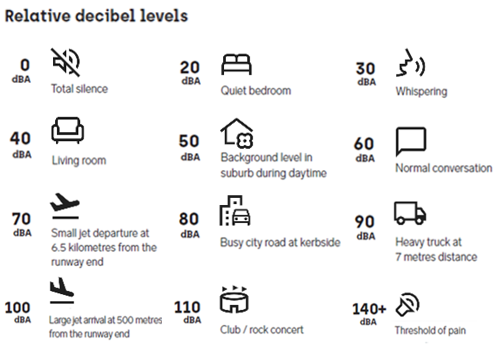
<a href=" relative-db-level.png">
  <img decoding=

How do aircraft generate noise?

The noise generated by aircraft has two main sources: air passing over the aircraft airframe, and the aircraft engines. The air passing over the airframe (fuselage and wings) causes friction and turbulence, which results in sound waves. More noise is generated when the aircraft’s landing gear and wing flaps are used, as these create more wind resistance. Some studies indicate that 30 to 50 per cent of the noise at take-off and landing can be caused by wind friction. Engine noise is created by the sound of the moving engine parts and that of air being expelled at high speed (or in the case of propellor-driven aircraft and helicopters, the sound from the rotating blades cutting through air).

The aircraft noise heard at ground level is influenced by a range of factors, including:

  • aircraft type and size —fuselage design, type of engines and the specific aircraft performance all impact on the noise being generated
  • the way the aircraft is being flown by the pilot
  • the aircraft weight and rate at which it climbs—longer flights generally require more fuel on departure, resulting in higher thrust settings and a slower climb due to the weight, and
  • meteorological conditions—temperature, wind speed and direction, humidity, rain and cloud-cover all impact on the reverberation of sound waves.

Aircraft have been getting progressively quieter due to advances in aerodynamic design and engine technology. Australia has one of the most modern aircraft fleets in the world.

How is aircraft noise controlled?

Aircraft noise has been controlled since the 1970s by the setting of noise limits for aircraft in the form of standards and recommended practices contained in Annex 16 to the Convention on International Civil Aviation.

The Australian Government has established the Air Navigation (Aircraft Noise) Regulations 2018 (Cth) which require aircraft operating in Australian airspace to comply with the noise standards and recommended practices set out in Annex 16.

Over the years, the International Civil Aviation Organization (ICAO) has set progressively tighter certification standards, referred to as ‘chapters’, which set noise level compliance criteria for different types of civil aircraft during take-off and landing. The primary purpose of noise certification is to ensure that the latest available noise reduction technology is incorporated into aircraft design.

Are aircraft getting quieter?

Today’s modern aircraft produce significantly less noise than older aircraft, producing around 75% less noise than the aircraft which were operating in the 1970s due to technological advancements in engine and airframe design.

Australia has one of the most modern aircraft fleets in the world. All new passenger aircraft designs certified since 2017, such as the Boeing 737 MAX, Boeing 787 Dreamliner, Airbus A320neo, Airbus A350 and Airbus A330neo, meet the current, and most stringent, ICAO Chapter 14 noise standards.

The use of these aircraft at Perth Airport will continue to grow, with the two largest airlines, Qantas Group and Virgin Australia both making significant investment in new aircraft over the next decade.